
Disclosure: This article may contain affiliate links. This means we may earn a commission at no extra cost to you. As an Amazon Associate, we earn from qualifying purchases. We may also recommend products and services through other affiliate programs.
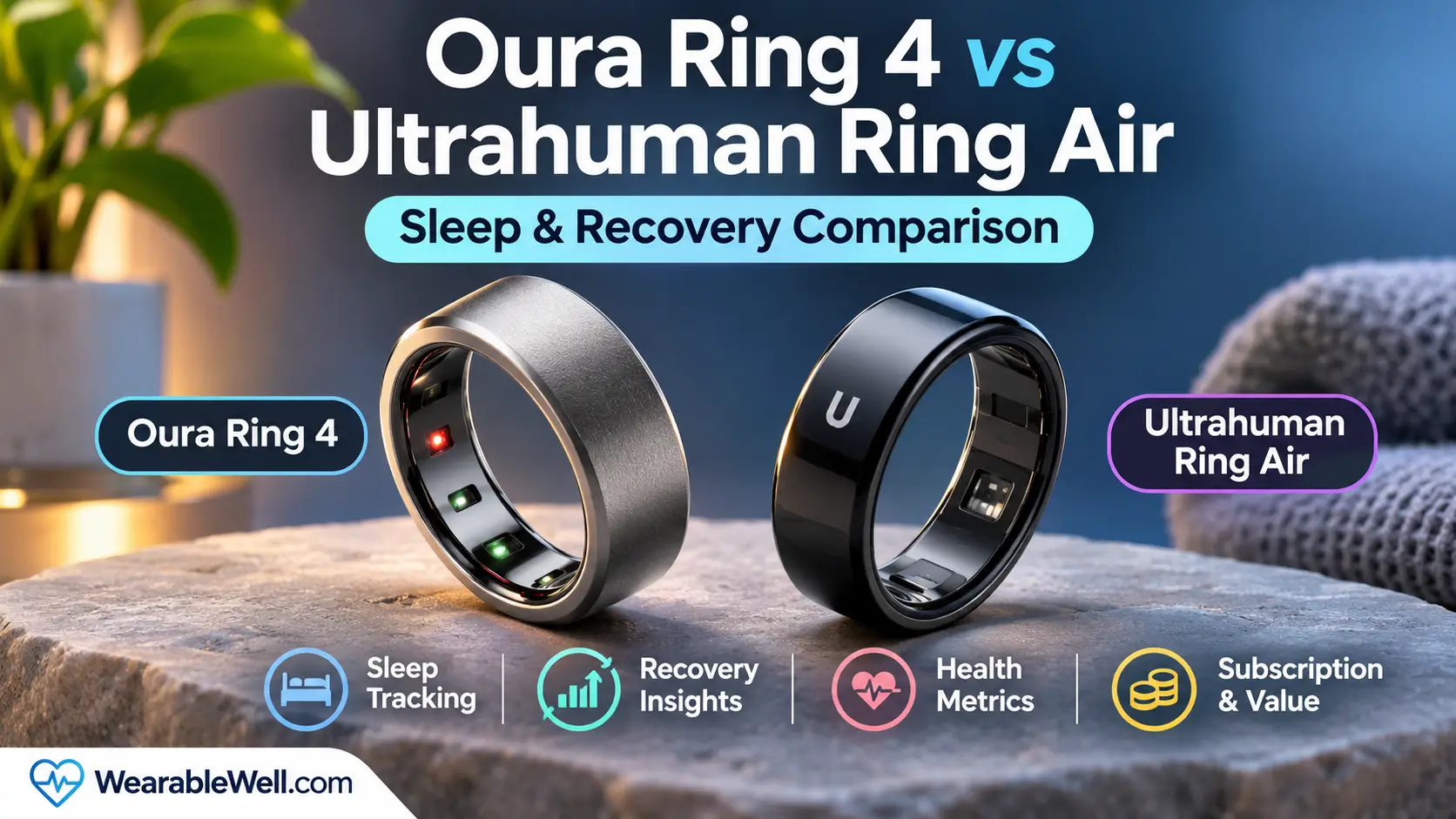
Table of Contents
Introduction: Oura Ring 4 vs Ultrahuman Ring Air
Choosing between the Oura Ring 4 and Ultrahuman Ring Air can be surprisingly difficult. Both are designed to monitor sleep, recovery, and everyday health trends without requiring you to wear a smartwatch overnight. But their approaches to health insights, app features, and long-term costs are different.
The Oura Ring 4 emphasizes easy-to-understand sleep and readiness scores, helping users recognize patterns in their rest and daily routines. The Ultrahuman Ring Air takes a more data-focused approach, with insights related to sleep, recovery, and circadian rhythms.
One of the biggest differences is how you pay for the experience. Oura offers a paid membership for access to its full range of insights, while Ultrahuman provides many of its core Ring Air features without a mandatory recurring subscription. Optional paid services and regional availability may affect the overall cost.
But which ring makes more sense for your needs? Is Oura’s app experience worth the ongoing membership fee, or does Ultrahuman offer better long-term value?
In this comparison, we’ll examine sleep tracking, heart rate variability (HRV), recovery insights, comfort, battery life, app features, and ownership costs. We’ll also explain where accuracy claims require caution, so you can make a more informed decision.
For a broader look at the category, see our guide to whether smart rings are worth buying.
Quick Comparison: Oura Ring 4 vs Ultrahuman Ring Air
Both smart rings focus on sleep, recovery, and long-term health trends, but they differ in how they present information and structure their services.
| Feature | Oura Ring 4 | Ultrahuman Ring Air |
|---|---|---|
| Sleep tracking | Sleep duration, stages, and Sleep Score | Sleep duration, stages, and Sleep Index |
| Recovery insights | Readiness Score and recovery trends | Recovery insights and related health metrics |
| Heart rate and HRV | Yes | Yes |
| Temperature tracking | Yes | Yes |
| Activity tracking | Yes | Yes |
| Circadian rhythm insights | Sleep timing and body-clock features | Circadian and sleep-timing guidance |
| App experience | Emphasis on summarized scores and trends | Emphasis on detailed metrics and recommendations |
| Subscription model | Paid membership for full insights | Core features without a mandatory subscription; optional paid services may apply |
| Battery life | Up to 8 days advertised | Approximately 4–6 days advertised |
| Best suited for | Users who prefer a guided wellness experience | Users who prioritize core features without a mandatory recurring fee |
Battery life varies with ring size, settings, and usage. Feature availability, subscriptions, and services may change over time.
The Biggest Difference
Oura Ring 4 may appeal more to people who prefer an app built around summarized sleep, readiness, and wellness insights.
Ultrahuman Ring Air may be more attractive to buyers who want detailed health trends without committing to a mandatory subscription for its core tracking features.
Neither ring should be considered a medical diagnostic device, and the presence of similar sensors does not establish equal measurement accuracy.
Design & Comfort: Which Smart Ring Is Easier to Wear?
Comfort matters when choosing a smart ring, especially if you plan to wear it overnight. Both the Oura Ring 4 and Ultrahuman Ring Air are designed for continuous wear, but their weight, thickness, and fit may influence your experience.
Weight, Thickness, and Materials
The Oura Ring 4 features a titanium design with a smooth interior. Depending on ring size, it weighs approximately 3.3–5.2 grams and measures around 2.88 mm thick.
The Ultrahuman Ring Air also uses a titanium-based construction. It weighs approximately 2.4–3.6 grams, depending on size, and measures around 2.45 mm thick.
On paper, the Ultrahuman Ring Air is lighter and thinner. However, these specifications alone cannot determine which ring will feel more comfortable on your finger.
Comfort During Sleep
Both rings are designed to track sleep without requiring a smartwatch on your wrist.
The Ultrahuman Ring Air’s lighter construction may appeal to people who prefer minimal weight, while the Oura Ring 4’s smooth interior may appeal to those who prioritize a consistent fit.
Actual comfort depends on your finger size, hand shape, and how the ring fits throughout the day and night.
Sizing and Everyday Wear
Getting the correct size is particularly important for smart rings because sensor contact affects the quality of collected data.
Finger size can change slightly with temperature, activity, and time of day. For this reason, it’s sensible to use the manufacturer’s sizing kit and test the fit before ordering.
Do not assume that your usual jewelry ring size will match either manufacturer’s sizing system.
Which Ring Wins for Comfort?
Verdict: Ultrahuman Ring Air has an advantage in weight and thickness, but overall comfort is subjective.
If you prefer the lightest possible ring, the Ultrahuman Ring Air may be the more appealing option.
If you’re considering the Oura Ring 4, its smooth interior and sizing options are also worth evaluating.
For either device, choosing the correct size is likely to matter more than a small difference in weight.
Sleep Tracking Comparison: Oura Ring 4 vs Ultrahuman Ring Air
Sleep tracking is one of the main reasons people buy smart rings. Both the Oura Ring 4 and Ultrahuman Ring Air monitor overnight patterns, including sleep duration, estimated sleep stages, resting heart rate, and heart rate variability (HRV).
However, the two devices differ in how they organize this information and help users interpret it.
Oura Ring 4: Sleep Scores and Long-Term Trends
The Oura Ring 4 focuses on making sleep data easier to understand through its Sleep Score and supporting metrics.
Its sleep-related features include:
- Sleep duration: Estimates how long you sleep each night.
- Sleep stages: Estimates time spent in light, deep, and REM sleep.
- Sleep Score: Summarizes several sleep-related measurements into a single score.
- Sleep timing and regularity: Helps users recognize patterns in their sleep schedules.
- Overnight heart rate and HRV: Provides additional context about physiological changes during rest.
Oura also connects sleep information with its Readiness Score, helping users see how overnight patterns relate to their broader recovery trends.
This approach may appeal to people who prefer a clear daily summary rather than interpreting numerous individual measurements.
Access to Oura’s full range of sleep insights generally requires an active membership.
Ultrahuman Ring Air: Sleep and Circadian Insights
The Ultrahuman Ring Air also tracks sleep-related measurements but places additional emphasis on timing, routines, and actionable recommendations.
Its features include:
- Sleep Index: Provides an overall summary of sleep-related measurements.
- Sleep duration and stages: Estimates total sleep and time spent in different sleep stages.
- Overnight heart rate and HRV: Helps users observe physiological trends during sleep.
- Circadian insights: Offers guidance related to sleep timing and daily rhythms.
- Recovery-related metrics: Connects overnight measurements with broader wellness insights.
Ultrahuman may appeal to users who enjoy exploring detailed information and experimenting with changes to their daily routines.
Many core Ring Air tracking features are available without a mandatory recurring subscription, although some additional services may cost extra.
Which Smart Ring Is More Accurate for Sleep?
Neither ring can reliably identify every sleep stage with the precision of a clinical sleep study.
Both devices estimate sleep stages using signals such as movement, heart rate, and other physiological measurements. These estimates can be useful for observing patterns, but they are not direct measurements of brain activity.
Clinical polysomnography, which records signals including brain activity, remains the reference standard for evaluating sleep stages.
Research supporting particular Oura models or algorithms should not automatically be treated as evidence that every Oura generation outperforms the Ultrahuman Ring Air. A fair accuracy comparison requires independent testing of the specific devices against an appropriate reference method.
For everyday use, it is generally more useful to look at consistent trends over several weeks than to treat a single night’s estimated REM or deep-sleep duration as an exact measurement.
Sleep Tracking Verdict
Choose Oura Ring 4 if you prefer straightforward sleep summaries, historical trends, and an app experience centered on interpreting your nightly rest.
Consider Ultrahuman Ring Air if you want sleep tracking combined with circadian guidance and detailed wellness insights, without a mandatory subscription for its core features.
Neither device can diagnose sleep apnea, insomnia, or another sleep disorder based on its consumer sleep scores alone. If you experience persistent sleep problems, seek advice from a qualified healthcare professional.
HRV & Recovery Tracking: Which Smart Ring Offers Better Insights?
Heart rate variability (HRV) is one of the measurements used by both the Oura Ring 4 and Ultrahuman Ring Air to provide insights into recovery and physiological trends.
HRV describes the variation in time between consecutive heartbeats. It is influenced by the autonomic nervous system and can change with sleep, physical activity, illness, stress, and other factors.
However, a higher HRV does not automatically mean better health, and a lower reading does not necessarily indicate a problem. Age, individual physiology, measurement conditions, and personal baseline all matter.
Oura Ring 4: Readiness and Recovery Trends
Oura combines several measurements to help users understand how their bodies may be responding to daily demands.
Its recovery-related insights include:
- Overnight HRV: Tracks changes in heart rate variability during sleep.
- Resting heart rate: Helps identify changes from typical overnight patterns.
- Temperature trends: Provides additional context about physiological changes.
- Readiness Score: Summarizes multiple signals into an easy-to-understand daily score.
- Long-term trends: Helps users compare recent measurements with their personal baseline.
Oura’s main advantage is how it organizes these measurements into accessible summaries.
For people who want to check their recovery trends without examining every metric individually, this approach may be particularly appealing.
Ultrahuman Ring Air: Recovery and Lifestyle Insights
Ultrahuman also uses HRV, heart rate, temperature-related measurements, and sleep data to provide recovery-oriented insights.
Its approach emphasizes understanding how daily habits and routines may relate to physiological trends.
Depending on current app features, users can explore:
- HRV trends: Changes in overnight heart rate variability.
- Resting heart rate: Patterns that may provide context about recovery.
- Sleep-related recovery insights: Information connecting overnight measurements with broader wellness trends.
- Circadian guidance: Recommendations related to daily timing and routines.
- Lifestyle patterns: Opportunities to explore how habits may correlate with tracked measurements.
This approach may appeal to users who prefer detailed metrics and want to experiment with adjustments to their routines.
Can HRV Tell You Whether You Have Recovered?
HRV can provide useful context, but it is not a direct measurement of recovery.
For example, an unusually low overnight HRV reading might occur after poor sleep, strenuous exercise, illness, or other physiological stressors. It does not identify the cause by itself.
Similarly, a favorable recovery score does not guarantee that your body is fully recovered or ready for intense exercise.
For a more meaningful interpretation, consider:
- Your individual HRV baseline rather than comparisons with other people.
- Trends over several nights instead of isolated readings.
- Sleep quality, fatigue, training demands, and how you actually feel.
- Whether measurements were collected under reasonably consistent conditions.
Neither smart ring should be used to diagnose cardiovascular conditions or make medical decisions based solely on HRV.
HRV & Recovery Verdict
Oura Ring 4 may be the better fit if you want recovery information presented through a simple Readiness Score and easy-to-follow trends.
Ultrahuman Ring Air may appeal more if you prefer exploring recovery metrics alongside sleep timing and lifestyle guidance.
There is not enough evidence in this comparison to declare either device universally more accurate at measuring HRV. Differences in sensors, algorithms, and measurement conditions can affect results.
For more information about how Oura interprets stress-related signals, read our guide to Oura Ring stress tracking accuracy.
App Experience & Insights: Oura vs Ultrahuman
A smart ring is only as useful as the information you can understand and act on. While both devices collect health-related data, their companion apps take different approaches to presenting insights and helping users recognize patterns.
Oura App: Simple Scores and Guided Insights
The Oura app emphasizes clear summaries that make it easier to follow changes in sleep, recovery, and daily activity.
Its main strengths include:
- Sleep Score: A daily summary of your estimated sleep quality and related measurements.
- Readiness Score: Combines several physiological signals to provide recovery-related guidance.
- Activity insights: Helps users monitor movement and activity patterns.
- Historical trends: Makes it easier to compare recent measurements with longer-term patterns.
- Personalized guidance: Provides recommendations based on tracked data and individual trends.
Rather than requiring users to interpret every measurement separately, Oura organizes much of the information into scores and explanations.
This may be especially helpful for beginners or people who prefer a straightforward daily overview.
However, access to the app’s full range of insights generally requires an active Oura membership.
Ultrahuman App: Detailed Metrics and Lifestyle Guidance
The Ultrahuman app places greater emphasis on exploring physiological measurements and understanding how daily routines may relate to sleep and recovery.
Its experience includes:
- Sleep Index: Summarizes sleep-related measurements.
- Recovery insights: Helps users explore changes in overnight physiological signals.
- HRV and heart rate trends: Provides context for understanding changes over time.
- Circadian guidance: Focuses on sleep timing and daily routines.
- Lifestyle recommendations: Encourages users to examine patterns that may influence rest and recovery.
Users who enjoy reviewing multiple metrics and experimenting with changes to their routines may find this approach appealing.
Many of the Ring Air’s core tracking features are available without a mandatory recurring subscription. However, optional paid features or services may be offered separately.
Which App Is Easier to Use?
The answer depends on how you prefer to interact with your health data.
Oura Ring 4 may suit you if you want to open an app, review a few key scores, and quickly understand your recent trends.
Ultrahuman Ring Air may suit you if you prefer exploring more detailed measurements and guidance related to sleep timing and lifestyle habits.
Neither approach guarantees better health outcomes. The most useful app is the one that helps you interpret trends consistently without becoming overly focused on individual readings.
App Experience Verdict
Oura has an advantage for users who prioritize simplified scores and guided explanations.
Ultrahuman offers an appealing alternative for users who prefer detailed metrics and core tracking features without a mandatory subscription.
Both apps may change as their manufacturers introduce new features, so the available experience can vary with software updates and service plans.
Subscription vs No Subscription: Which Smart Ring Costs Less Over Time?
The purchase price is only part of the cost of owning a smart ring. Before choosing between the Oura Ring 4 and Ultrahuman Ring Air, it’s important to understand which features require ongoing payments.
Oura Ring 4: Paid Membership for Full Insights
Oura uses a membership-based model. In the United States, membership costs $5.99 per month or $69.99 per year, with the first month included for new members.
An active membership unlocks detailed sleep analysis, heart rate and HRV trends, temperature insights, stress-related features, and personalized recommendations.
Without an active membership, the Oura app provides a much more limited experience. Users can still view their daily Sleep, Readiness, and Activity scores, along with basic device information, but most detailed insights are unavailable.
This means buyers should consider both the ring’s purchase price and the recurring membership cost.
Ultrahuman Ring Air: Core Tracking Without a Mandatory Subscription
The Ultrahuman Ring Air takes a different approach. Its core sleep, recovery, and health-tracking features are designed to be accessible without a mandatory monthly membership.
This can make the Ring Air attractive to buyers who prefer paying for their device upfront rather than maintaining an ongoing subscription.
However, this does not mean every Ultrahuman service is necessarily free. Optional premium features, additional services, or related products may involve separate charges.
Before purchasing, check which features are included in your region and whether any optional services interest you.
How Much Does Oura Membership Add Over Three Years?
The following example shows the cost of Oura’s US membership alone, excluding the ring purchase price and taxes.
| Membership period | Monthly plan | Annual plan |
|---|---|---|
| 12 paid months | $71.88 | $69.99 |
| 24 paid months | $143.76 | $139.98 |
| 36 paid months | $215.64 | $209.97 |
These figures illustrate full paid billing periods. The introductory free month may reduce the amount paid during the first calendar year. Membership prices and availability vary by country.
For example, three full years of Oura’s annual membership would add approximately $210 to the ring’s purchase price at current US rates.
By comparison, the Ultrahuman Ring Air does not require an equivalent recurring membership for its core tracking experience.
Subscription Verdict
Ultrahuman Ring Air has the advantage for buyers who want to avoid mandatory recurring membership fees.
Oura Ring 4 may still be worth the additional cost for users who prefer its app experience and membership-based insights.
The better value depends on the ring’s actual purchase price, the features you use regularly, and how long you plan to keep the device.
Battery Life: Oura Ring 4 vs Ultrahuman Ring Air
Battery life is an important consideration for smart rings, particularly because regular charging can interrupt overnight sleep tracking.
Both the Oura Ring 4 and Ultrahuman Ring Air are designed to operate for several days between charges, but their advertised battery life differs.
Battery Life Comparison
| Feature | Oura Ring 4 | Ultrahuman Ring Air |
|---|---|---|
| Advertised battery life | Up to 8 days | Approximately 4–6 days |
| Charging method | Dedicated charging dock | Dedicated charging equipment |
| Actual battery life | Varies by size, settings, and usage | Varies by size, settings, and usage |
Oura Ring 4 Battery Life
Oura advertises up to eight days of battery life for the Ring 4 under its specified testing conditions.
This may appeal to users who prefer fewer charging interruptions, especially when tracking sleep consistently.
However, the eight-day figure is a maximum estimate rather than a guarantee. Actual performance depends on factors such as ring size, enabled features, battery condition, and usage patterns.
Ultrahuman Ring Air Battery Life
Ultrahuman advertises approximately four to six days of battery life for the Ring Air.
For many users, this may be sufficient for continuous sleep and recovery tracking, although charging may be needed more frequently than with the Oura Ring 4.
As with Oura, actual battery performance can vary depending on device settings, usage, and battery condition.
Which Ring Has Better Battery Life?
Oura Ring 4 has the advantage based on advertised maximum battery life.
Its stated maximum of eight days exceeds the Ring Air’s advertised four-to-six-day range.
However, these figures come from manufacturer specifications rather than a controlled, independent comparison. They should not be interpreted as a guarantee that every Oura Ring 4 will last longer under all conditions.
For either device, establishing a regular charging routine can help reduce gaps in sleep and recovery data.
Accuracy: Oura Ring 4 vs Ultrahuman Ring Air
Accuracy is one of the most important considerations when choosing a health-tracking smart ring. Both the Oura Ring 4 and Ultrahuman Ring Air measure physiological signals to estimate sleep patterns, heart rate variability (HRV), recovery, and other wellness trends.
However, having similar tracking features does not mean the two devices deliver equally accurate results.
What Does Research Say About Oura Ring 4?
Oura Ring 4 has been evaluated in peer-reviewed research examining overnight resting heart rate and HRV measurements.
A 2025 study published in Physiological Reports compared five consumer wearables against an electrocardiogram (ECG) reference during sleep.
The researchers collected data from 13 healthy adults across 536 cumulative nights of monitoring.
For Oura Ring 4, the study reported:
- Resting heart rate: A concordance correlation coefficient of 0.98 and a mean absolute percentage error of approximately 1.94%.
- Heart rate variability: A concordance correlation coefficient of 0.99 and a mean absolute percentage error of approximately 5.96%.
These findings support Oura Ring 4’s ability to measure overnight resting heart rate and HRV with relatively strong agreement under the conditions studied.
However, the study involved a small group of healthy adults. Its findings should not automatically be generalized to every population, health condition, or tracking feature.
Scientific source: Validation of Nocturnal Resting Heart Rate and Heart Rate Variability in Consumer Wearables (2025).
How Accurate Is Ultrahuman Ring Air?
Ultrahuman Ring Air also uses optical sensing and software algorithms to estimate heart rate, HRV, sleep patterns, and recovery-related metrics.
Ultrahuman has published technical research examining the agreement between its updated overnight HRV measurements and an ECG chest-strap reference.
The reported findings suggest that its HRV measurements can provide useful information under the conditions tested. However, the analysis involved a limited number of nights and should not be treated as conclusive evidence of accuracy across all users or measurements.
Manufacturer-published research is informative, but its methodology, sample size, and potential conflicts of interest should be considered.
Research source: Ultrahuman Ring HRV Accuracy Study.
Can We Say Oura Is More Accurate Than Ultrahuman?
Not conclusively.
Oura Ring 4 has encouraging peer-reviewed validation evidence for overnight heart rate and HRV measurements.
Ultrahuman Ring Air also has supporting technical evidence, but the available studies use different methods and testing conditions.
Because these findings do not come from a single controlled head-to-head study, their reported accuracy figures should not be directly compared to declare a definitive winner.
Sleep-stage accuracy is another consideration. Both devices estimate sleep stages indirectly, and neither replaces clinical polysomnography.
Why Accuracy Can Vary
Several factors can affect smart ring measurements:
- Ring fit and sensor contact with the skin.
- Movement during measurement.
- Individual physiological differences.
- Sensor and algorithm limitations.
- Software updates that change how data is processed.
For everyday wellness tracking, consistent measurements over time may be more useful than relying on a single night’s score.
Accuracy Verdict
Oura Ring 4 has strong published validation evidence for overnight resting heart rate and HRV.
Ultrahuman Ring Air also offers physiological tracking, but its accuracy should be evaluated according to the available evidence for each measurement.
Based on the research discussed here, there is insufficient comparable evidence to declare one ring universally more accurate than the other.
Neither device should replace professional medical evaluation or diagnostic testing.
Everyday Use: Which Smart Ring Fits Your Lifestyle?
The Oura Ring 4 and Ultrahuman Ring Air are designed to fit into everyday life, but the experience you get from each device depends on what you expect from a health-tracking ring.
Rather than focusing on which ring looks better on paper, consider how you plan to use its insights over time.
Choose Oura Ring 4 If You Want:
- Easy-to-understand daily summaries: Oura organizes sleep, readiness, and activity information into scores that are relatively straightforward to interpret.
- A guided wellness experience: The app helps users recognize patterns without requiring them to analyze every measurement individually.
- Long-term trend tracking: Historical information can help you understand how your sleep and recovery-related measurements change over time.
- Less frequent charging: Oura advertises up to eight days of battery life, although actual performance varies.
- A membership-based experience: You are comfortable paying an ongoing fee to access the full range of app insights.
Oura may be particularly appealing if your main goal is to develop more consistent sleep habits and follow general recovery trends through a structured app experience.
Choose Ultrahuman Ring Air If You Want:
- Core tracking without a mandatory subscription: Many essential Ring Air features are available without a recurring membership.
- A lightweight design: The Ring Air is lighter and thinner on paper, which may appeal to users who prefer minimal bulk.
- Detailed wellness metrics: The app provides information related to sleep, HRV, recovery, and daily routines.
- Circadian rhythm guidance: Its emphasis on sleep timing may interest users who want to examine how their routines relate to rest.
- More predictable core ownership costs: Avoiding a mandatory membership can reduce ongoing expenses, although optional paid services may still be available.
Ultrahuman may be a suitable choice if you enjoy exploring health trends and prefer not to commit to an ongoing subscription for core tracking.
What About Comfort and Daily Activities?
Both rings are intended for regular wear, including overnight sleep tracking.
However, comfort is personal. Finger shape, sizing, temperature changes, and daily activities can all affect how a ring feels.
Neither ring is necessarily ideal for every activity. For example, wearing a ring while lifting heavy weights or handling equipment can be uncomfortable and may create safety risks.
It’s sensible to follow the manufacturer’s guidance and remove your ring when an activity could cause injury or damage.
Everyday Use Verdict
Choose Oura Ring 4 if you value simplified insights, guided interpretation, and longer advertised battery life.
Consider Ultrahuman Ring Air if you prioritize a lighter design, detailed metrics, and core tracking without a mandatory subscription.
Neither choice guarantees better sleep or recovery. The value comes from whether the information helps you understand your habits and make practical, sustainable changes.
Which Smart Ring Should You Buy?
Choosing between the Oura Ring 4 and Ultrahuman Ring Air comes down to three main factors: how you prefer to interpret your health data, whether you want to pay a recurring subscription, and which features matter most to your daily routine.
Both rings offer sleep and recovery tracking, but neither is automatically the best choice for everyone.
Best for Guided Sleep and Recovery Insights: Oura Ring 4
The Oura Ring 4 is a strong option for buyers who prefer an organized wellness experience.
Its Sleep and Readiness Scores make it easier to follow trends without interpreting every individual measurement. It also offers long-term tracking features and up to eight days of advertised battery life.
Oura Ring 4 may be the better choice if:
- You primarily want to understand sleep and recovery trends.
- You prefer straightforward scores and explanations.
- You value a structured app experience.
- You are comfortable paying for an ongoing membership.
The main drawback: Most detailed insights require a paid Oura membership, increasing the total cost of ownership.
Interested in the Oura Ring 4? Check Oura Ring 4 availability on Amazon.
Best for Subscription-Free Core Tracking: Ultrahuman Ring Air
The Ultrahuman Ring Air is an appealing alternative for buyers who want detailed wellness information without a mandatory subscription for core features.
It combines sleep tracking, HRV trends, recovery-related insights, and circadian guidance in a lightweight design.
Ultrahuman Ring Air may be the better choice if:
- You want to avoid a mandatory monthly membership.
- You prefer a lighter, thinner ring.
- You enjoy exploring detailed health metrics.
- You are interested in sleep timing and lifestyle guidance.
The main drawback: Its advertised battery life is shorter than Oura Ring 4’s maximum, and its app experience may not suit users who prefer simpler summaries.
Our Recommendation
Choose Oura Ring 4 if guided sleep and recovery insights are your highest priorities and you are comfortable with the membership cost.
Choose Ultrahuman Ring Air if avoiding a mandatory subscription and exploring detailed wellness trends matter more to you.
Before buying either ring, check the current price, regional availability, return policy, and sizing requirements. A sizing kit is particularly important because smart ring sizes may differ from standard jewelry sizes.
Neither device should be purchased as a substitute for medical diagnostic equipment.
Availability note: At the time of this update, the Ultrahuman Ring Air listings we checked on Amazon.com were marked as currently unavailable. Availability may change, so check current stock and purchasing options before making a decision.
Are Oura Ring 4 and Ultrahuman Ring Air the Best Smart Rings?
The Oura Ring 4 and Ultrahuman Ring Air are two options worth considering for sleep and recovery tracking, but they are not necessarily the best choices for every buyer.
Other smart rings may offer different advantages, including alternative pricing models, activity-tracking features, designs, and compatibility with specific smartphone ecosystems.
Before choosing a smart ring, consider what matters most to you:
- Sleep and recovery insights: Look for features that help you understand long-term trends rather than individual scores alone.
- Subscription costs: Compare the total cost of ownership, not just the purchase price.
- Comfort and sizing: A properly fitted ring is essential for comfortable overnight wear and consistent sensor contact.
- App compatibility: Check whether the device supports your smartphone and the health platforms you use.
- Scientific evidence: Consider whether the manufacturer provides meaningful validation for the measurements you care about.
If you’re still comparing options, explore our guide to the best smart rings for health monitoring.
The right smart ring is the one that fits your budget, works with your daily routine, and provides information you can use consistently.
Final Verdict: Oura Ring 4 vs Ultrahuman Ring Air
The Oura Ring 4 and Ultrahuman Ring Air offer two different approaches to monitoring sleep, recovery, and everyday wellness.
Oura Ring 4 is our preferred option for users who value guided sleep and recovery insights. Its organized Sleep and Readiness Scores, long-term trends, and straightforward app experience make it appealing to people who want to understand their data without spending too much time analyzing individual metrics.
However, Oura’s ongoing membership fee is an important consideration, particularly if you plan to use the ring for several years.
Ultrahuman Ring Air is a compelling alternative for buyers who want core health tracking without a mandatory subscription. Its lightweight design, detailed wellness metrics, and emphasis on circadian guidance may appeal to users who enjoy exploring their data and adjusting their routines.
Neither device is guaranteed to provide more accurate measurements in every situation. Although Oura Ring 4 has encouraging published validation evidence for certain overnight measurements, the available research does not establish that it outperforms Ultrahuman Ring Air across all tracking features.
Our Final Recommendation
- Choose Oura Ring 4 if you prefer simplified sleep and recovery insights, longer advertised battery life, and a guided app experience.
- Choose Ultrahuman Ring Air if you prioritize subscription-free core tracking, a lighter design, and detailed wellness information.
Before purchasing, compare current prices, confirm smartphone compatibility, and use the appropriate sizing kit.
Bottom line: Oura Ring 4 may be the better fit for a guided wellness experience, while Ultrahuman Ring Air may offer better long-term value for buyers who want to avoid mandatory recurring fees.
The best choice is the ring whose features, costs, and daily experience match your needs.
Frequently Asked Questions (FAQs)
Which is better, Oura Ring 4 or Ultrahuman Ring Air?
Oura Ring 4 may be the better choice for users who prefer guided sleep and recovery insights, straightforward scores, and a structured app experience. Ultrahuman Ring Air may be more suitable for buyers who want detailed wellness metrics without a mandatory subscription for core tracking. The best option depends on your priorities and budget.
Does Oura Ring 4 require a subscription?
An Oura membership is required to access most detailed sleep, recovery, and health insights. Without a membership, the app provides a limited experience, including basic daily scores. In the United States, membership costs $5.99 per month or $69.99 per year, although pricing varies by region.
Does Ultrahuman Ring Air require a monthly subscription?
No mandatory monthly subscription is required for the Ring Air’s core tracking features. However, Ultrahuman may offer optional paid services or premium features separately. Check the current terms before purchasing.
Which smart ring is more accurate for sleep tracking?
There is insufficient directly comparable evidence to conclude that either ring is universally more accurate at tracking sleep. Both estimate sleep duration and stages using physiological signals and algorithms. Neither replaces clinical polysomnography, which is used to evaluate sleep disorders.
Is Ultrahuman Ring Air accurate for HRV and heart rate?
Ultrahuman Ring Air measures heart rate and HRV using optical sensors. Available technical evidence suggests these measurements can be useful for observing trends, but accuracy may vary with fit, movement, individual physiology, and measurement conditions. The readings should not be treated as medical diagnoses.
Which ring has better battery life?
Oura Ring 4 advertises up to eight days of battery life, while Ultrahuman Ring Air advertises approximately four to six days. Actual performance varies depending on ring size, settings, and usage.
Which smart ring is better for beginners?
Oura Ring 4 may be easier for beginners who prefer summarized scores and guided explanations. Ultrahuman Ring Air may appeal to beginners who want to explore detailed health metrics without paying a mandatory recurring membership fee.
Which ring offers better long-term value?
Ultrahuman Ring Air may offer better long-term value for users who want to avoid mandatory subscription fees. However, the final comparison depends on current device prices, optional services, and how much you value Oura’s membership-based features.
Can either smart ring diagnose sleep or heart conditions?
No. Neither ring should be used as a substitute for professional medical assessment or diagnostic testing. If you have persistent sleep problems, unusual heart-related symptoms, or other health concerns, consult a qualified healthcare professional.